

Understanding the Income-tax Department’s e-Verification Communications: What It Means, Why You Received It, and How to Respond Correctly
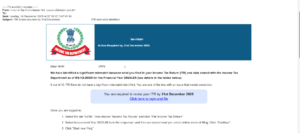
In last few days, a significant number of taxpayers in India have received emails from the Income Tax Department’s Insight Portal, sent from the official email ID itd_support@insight.gov.in. These emails typically inform taxpayers that either:
-
They have not filed their Income-tax Return (ITR) for a particular assessment year, or
-
Certain financial transactions reflected in departmental records have not been disclosed or appear inconsistent with the income reported in the return already filed.
Such emails often create anxiety because they resemble statutory notices. However, they form part of the Income Tax Department’s e-Verification and e-Campaign initiative, which is a pre-notice compliance mechanism. This article explains the meaning of these emails, the legal framework behind them, common issues noticed in practice, and the correct procedure to respond.
What Is the Insight Portal of the Income Tax Department?
The Insight Portal is an internal data analytics platform of the Income Tax Department that consolidates information received from multiple sources, including:
-
Annual Information Statement (AIS)
-
Taxpayer Information Summary (TIS)
-
Statement of Financial Transactions (SFT) reported under section 285BA
-
Banks, mutual funds, registrars, stock exchanges, and other reporting entities
-
Information received from other government authorities
Using this data, the Department identifies potential cases of non-filing of return, under-reporting of income, or mismatch between transactions and returned income. Based on such risk profiling, automated emails are issued under the e-Campaign / e-Verification drive.
Is the Email from itd_support@insight.gov.in a Legal Notice?
A critical line mentioned in these emails reads:
“This email has been sent to you as part of the Income Tax Department’s e-Verification communications. It is not a notice.”
From a legal standpoint:
-
These emails are not notices under the Income-tax Act, 1961.
-
They are not issued under sections like 142(1), 148, or 133(6).
-
However, the information flagged here often becomes the basis for future scrutiny or reassessment proceedings.
Therefore, while the email is not legally enforceable at this stage, it must be treated as an important compliance alert.
Common Reasons for Receiving Insight Portal Emails
Taxpayers usually receive these emails due to one or more of the following reasons:
-
Non-filing of Income-tax Return for a particular assessment year
-
High-value transactions reported in AIS/TIS not reflected in ITR
-
Cash deposits, property purchases, or investment transactions exceeding declared income
-
Incorrect or incomplete reporting by third parties
-
Technical issues such as invalid or unverified returns
Practical Observations and Initial Checks to Be Done
Based on professional experience, the following checks should be carried out immediately on receipt of such communication:
1. Verify PAN, Name, and Address Mentioned in the Email
It has been observed in several cases that:
-
The name of the taxpayer is correct, but
-
The PAN mentioned is incorrect, or
-
The address or jurisdiction does not match the taxpayer’s records
Such discrepancies usually arise due to third-party reporting errors or incorrect data mapping. Hence, the first step should always be to confirm whether the email actually pertains to the concerned taxpayer.
2. Check Whether the Reported Transaction Actually Belongs to You
The Insight Portal email may refer to:
-
Bank deposits or large credits
-
Mutual fund or share investments
-
Property transactions
-
Other high-value financial activities
Taxpayers should verify:
-
Whether the transaction genuinely belongs to them
-
Whether it relates to the correct assessment year
-
Whether it is a taxable transaction or merely a transfer, loan, or redeposit
In many cases, transactions may relate to joint holders, family members, or represent non-income items. Such facts must be properly clarified on the Compliance Portal.
3. In Case of Non-Filing Allegation, Verify Return Status Carefully
Where the email alleges non-filing of return, taxpayers should check:
-
Whether the return was filed within due date
-
Whether it was successfully e-verified
-
Whether the return was processed
-
Whether the return was treated as invalid or defective
A return that is filed but not verified or treated as invalid is often considered as “not filed” by the system.
No Response Option on Email or e-Proceedings – What to Do?
A common concern among taxpayers is that:
-
There is no option to reply through the email, and
-
The email clearly states:
“Please do not reply to this email as the inbox is not monitored.”
Further, there is usually no response option available under the “e-Proceedings” tab on the e-filing portal.
Correct Method to Respond: Compliance Portal via e-Campaign
The only prescribed way to respond to Insight Portal communications is through the Compliance Portal. The steps are as follows:
-
Login to the Income-tax e-Filing Portal
https://www.incometax.gov.in -
Go to the “Pending Actions” tab
-
Click on “Compliance Portal”
-
This will redirect you to the Insight-based Compliance Portal
-
-
Open the “e-Campaign” tab
-
Select the relevant issue and submit the appropriate response based on your facts and records
Importance of the “This Guide” Link in the Email
Each Insight Portal email contains a hyperlink titled “this guide”. This guide is crucial because it:
-
Explains the type of discrepancy or non-compliance identified
-
Provides structured response options such as:
-
Information is correct and already disclosed
-
Information is correct but not disclosed (with reasons)
-
Information is incorrect or does not belong to the taxpayer
-
Taxpayers should carefully select the correct option and provide accurate explanations, as these responses form part of the Department’s electronic records.
Why Ignoring Insight Portal Emails Can Be Risky
Although these emails are not statutory notices, failure to respond may result in:
-
Follow-up inquiry under section 133(6)
-
Notice under section 142(1) for details and explanations
-
Reassessment proceedings under sections 147 and 148, after section 148A procedure
Given that the reassessment regime is now information-based, non-compliance at this preliminary stage can significantly increase litigation risk.
Conclusion
Emails received from itd_support@insight.gov.in are part of the Income Tax Department’s technology-driven compliance framework. While they are not notices under the Income-tax Act, they act as early warning signals based on data available with the Department.
Taxpayers should:
-
Not ignore such emails
-
Verify PAN, transactions, and return status
-
Respond strictly through the Compliance Portal → e-Campaign route
-
Ensure factual and legally correct submissions
A timely and accurate response can effectively prevent scrutiny, reassessment, and prolonged income-tax litigation. In complex cases, professional assistance is advisable to ensure that the response is compliant with law and supported by proper documentation.
Guidance on above article on Income Tax by:

Naman Maloo (C.A., B.Com)
He is currently working as Partner – Direct Tax with a renowned firm in Jaipur having experience in dealing Assessments before Income Tax authority, Tax Audit, International Taxation, Tax planning for NRI, Business planning and consultation.
E-mail: naman.maloo@jainshrimal.in | LinkedIn: Naman Maloo
You can book phone consultation/ assistance online with expert as mentioned below:
To book ITR filing with experts CLICK ME.
To book phone consultation with experts for any Income tax related matters CLICK ME.
To book consultation for Faceless Assessment with experts CLICK ME.
To book phone consultation with experts for GST related matters CLICK ME.
To book general phone consultation with expert CLICK ME.